Chan Chun Sing stresses three traits public servants need for Singapore to thrive
For Singapore to thrive in the next 50 years, public servants need to have three traits in their DNA, Minister-in-charge of the Public Service Chan Chun Sing said yesterday.
One is a heart to understand the fears, concerns and aspirations of Singaporeans. Emphasising that the public service exists to serve the country and Singaporeans, he encouraged public servants to walk the ground and lead by example.
Two, strive to constantly do better, but with a slight "tweak".
"It is no longer about doing more, doing more with less or doing things more effectively with less.
"In the next leg, it is about doing better with our people, not just for our people," said Mr Chan, who is also Trade and Industry Minister.
The point reiterates Deputy Prime Minister Heng Swee Keat's earlier pledge to partner Singaporeans in building the Republic's future.
Three, spend time and effort to pre-empt tomorrow's challenges, and not just be happy to do bet-ter today.
Mr Chan was addressing 400 public servants and heads of public agencies at the Public Sector Transformation Awards event at Gardens by the Bay. About 80 awards were given to individuals and agencies to recognise excellence in fields such as citizen engagement, innovation and digitalisation. It is a highlight of the annual Public Service Week, which runs until tomorrow.
Likening the public service in some parts of the world to firefighters, Mr Chan said they tended to put out the flames only after the fire had started. "In Singapore, we want to make sure we are there to prevent the fire from starting."
He also said the biggest challenge for Singapore in the next 10 years will be leadership and relevance.
Leadership needs to prevail at every level of society. "It is our job to activate not just the talent in our (public) service, but to catalyse the entire nation to come along on this journey," he said.
He also said that Singapore need not fear challenges and external pressure for it to take sides in a more fragmented world, so long as it remains relevant.
"We will create the relevance for others to want to engage us as valued and worthy partners," he said, noting that the gardens and bay where they stood is "a testimony to our ability to dream big... and to the kind of environment we want to leave behind for our children".
He urged the officers to imagine what more they could leave behind for future generations.
"The power of the Singapore civil service is in catalysing the energies of Singaporeans living on this island. If we can do that, I am sure we will move towards SG100 with greater pride and confidence."
Unlock more articles at just $0.99/month
Subscribe to read all the stories you want today. Only $0.99/month for the first 6 months*.
Enrichment classes on coding for all upper primary pupils next year
SINGAPORE - All upper primary pupils will have coding classes from next year, as part of the Government's goal to develop a healthy pipeline of tech talent for the digital economy.
Conducted by the Education Ministry and Infocomm Media Development Authority (IMDA), the 10-hour enrichment programme will be piloted this year at some schools for pupils after their Primary School Leaving Examination (PSLE), before being rolled out to all primary schools by 2020.
Code For Fun (CFF) will seek to develop an appreciation of core computational thinking and coding concepts in pupils, through simple visual programming-based lessons.
This was one of several key announcements made by Minister for Communications and Information S. Iswaran at the ministry's workplan seminar, which centred around building a safe and inclusive digital society for Singapore that leaves no one behind.
At the seminar on Wednesday (July 10) at the Suntec Singapore Convention and Exhibition Centre, the minister also announced the formation of a new specialised telecoms cyber security specialist team, and more efforts to equip Singapore's ageing population with basic digital skills. He also gave an update on government initiatives to help companies digitalise their business.
Mr Iswaran said: "We are also reaching out to every enterprise, every worker, and every citizen, so that we can bring all of them, every enterprise regardless of its size, big or small, every worker regardless of education level and every citizen regardless of their tech savviness - bringing them into this overall national effort so that we can build a digital economy that is made up of enterprises that are digitally capable, empowered by workers who are digitally skilled and citizens who are digitally connected."
This, he said later, starts from young, and CFF will seek to excite young Singaporeans about the opportunities in the digital age and expose them to the skill sets needed for the potentially lucrative digital economy.
In 2016, a study by Oxford Economics and Huawei estimated that the size of the global digital economy amounted to about US$11.5 trillion (S$15.6 trillion) or over 15 per cent of global gross domestic product.
And closer to home, a study published by Microsoft last year estimated that the digital economy would contribute another US$10 billion to Singapore's GDP by 2021 to increase the growth rate by 0.6 per cent annually.
The Ministry of Communications and Information said in a fact sheet on Wednesday that since CFF was launched as an optional enrichment programme in 2014, it has benefited 93,000 students.
It added that the programme will continue at the secondary level as an option to complement existing efforts in computing education, which include computing subjects taken at O Level (elective) and A Level.
Mr Iswaran also announced that the Cyber Security Agency (CSA) will be expanding its youth engagement outreach with the Singapore Cyber Youth Programme (SG Cyber Youth), a collaboration with the cyber security industry and academia.
This programme will reach out to 10,000 secondary and tertiary students in the next three years to provide them with opportunities to explore cyber security as a career and expose them to relevant technical knowledge and soft skills.
It will build on CSA's existing efforts, which include the Youth Cyber Exploration Programme (YCEP) boot camp, a multi-day initiative which aims to introduce secondary school students to the opportunities of a cyber-security career and was started in collaboration with Singapore Polytechnic last year.
All five polytechnics are now involved in the boot camp, and this year's edition attracted a turnout of 400 students from over 30 secondary schools coming together to learn about cyber security.
Among other new initiatives under the new SG Cyber Youth will be a new advanced-level of the YCEP to be introduced next year, said the MCI.
The ministry added that students can also look forward to participating in cyber security learning journeys CSA holds with the Education Ministry and its industry partners, adding that more initiatives will be announced next year.
Unlock more articles at just $0.99/month
Subscribe to read all the stories you want today. Only $0.99/month for the first 6 months*.
Reversing the damage of a stroke: How one patient rehabilitated himself through sheer determination
(Illustration: Gracia Lam for The New York Times)
Strange as it may seem, the stroke Ted Baxter suffered in 2005 at age 41, leaving him speechless and paralysed on his right side, was a blessing in more ways than one. Had the clot, which started in his leg, lodged in his lungs instead of his brain, the doctors told him he would have died from a pulmonary embolism.
And as difficult as it was for him to leave his high-powered professional life behind and replace it with a decade of painstaking recovery, the stroke gave his life a whole new and, in many ways, more rewarding purpose.
Before the stroke, Baxter's intense work-focused life as a globe-trotting executive in international finance had eroded his marriage and deprived him of fulfilling relationships with family and friends. Unable to relax even on vacation, he rarely took time to smell the roses. Now, he told me, he leads a richer, calmer, happier life as a volunteer educator for stroke victims and their caregivers and for the therapists who treat them.
The stroke began with a cramping pain in his leg after a long international flight during which he wore compression hose to support his varicose veins. He didn't take the pain seriously until suddenly he couldn't talk or move the right side of his body. The clot that caused his leg pain had broken loose and cut off blood flow to the left side of his brain.
He nearly died. But once stabilised, the doctors discovered that he was born with a hole in his heart that had allowed the clot to bypass his lungs and go directly to his brain. Two of his siblings turned out to have the same defect, called patent foramen ovale, which they subsequently had repaired.
Baxter readily admits that his Type A personality, which was the driving force behind his professional success, was also a major factor that helped him reverse the extensive losses he suffered when the clot severely damaged his brain. And it inspired him to recount his 14 years of recovery and renewal in a fascinating book, Relentless: How a Massive Stroke Changed My Life for the Better, an apt title for what it took for him to regain full physical function, comprehension and intelligible speech.
His mantra, which could help many others facing a devastating health setback, is that recovery takes determination, focus, resiliency, persistence and courage – the courage to weather repeated setbacks and frustrations. He admits, however, that it can also take the financial resources and personal support he had to get the kind of help that can make a difference.
At first, his goal was to get right back in the saddle, working nonstop in finance. But after months of intense rehab, he still could neither use nor understand language, spoken or otherwise.
"It took seven or eight months for me to realise I wasn't going back to my job," he said. "I didn't even understand that the words coming from my mouth weren't making any sense."
The learning curve was steep: "I couldn't read; I couldn't write. I could see the hospital signs, the elevator signs, the therapists' cards, but I couldn't understand them," he wrote. The aphasia – the inability to understand or express speech – "had beaten and battered" his pride.
But he refused to give up. With age and prestroke physical conditioning on his side, he had convinced himself that "100 per cent recovery was possible as long as I pushed hard enough."
Baxter figured if he could get his body functioning again, his language facility might also return. The brain, he learned, was plastic and capable of renewal. So he devoted countless hours to physical therapy, worked out in the gym long and hard, and had his left arm tied behind his back, forcing himself to use the right. He found that as his physical abilities improved, so did his comprehension and communication skills.
When what he tried to say came out garbled, many people assumed he was either mentally slow or a foreigner with limited English. As one of his speech therapists said of people with aphasia, "It's hard to understand that they have their intellectual faculties and know what they want to say, but they don't have the ability to communicate it."
Baxter researched and enrolled in several different aphasia programs throughout the country. For many hours a day, he did language practice, starting with books and flash cards for preschoolers and doing endless repetitions to relearn speech until eventually – after years of hard work – he was finally able to read books and have real conversations.
His original therapists at the Rehabilitation Institute of Chicago, admittedly amazed at the progress he made, asked what benefited him the most and solicited his help developing a new, intensive aphasia programme. He was also invited to participate in Archeworks, a design program in Chicago for students working to solve urban problems.
"I faced the challenge of using my right hand, making new friends and communicating effectively with a team," he wrote. He was building things with his hands and tools and suddenly he realised he was problem-solving, a skill he had used often in finance.
Sports also aided his recovery. As he slowly regained use of his right side, he took lessons in golf and boxing, aided by watching others do things correctly.
"If I could see somebody do something, then I could follow it and mimic what they did," he wrote. "I had to focus on visualisation – picturing the task, the actions needed to perform that task and the intended result."
Art therapy was another helpful pursuit, which he said reduced his stress, countered depression and improved his self-esteem and emotional health. With art as a new source of fulfillment came an invitation to join a museum board that gave him additional conversational practice and "withered away my aphasia every day."
Gradually, Baxter said he "started to realise that by doing more for others, I'd be happier with myself."
Living now in Newport Beach, California, with his second wife, the 55-year-old stroke survivor devotes his life to inspiring other survivors and their caregivers. "I go to universities and hospitals to present my story – what I had experienced, how I rehabbed myself, how it changed my life for the better and what it took to get my life back," he wrote.
"Sometimes, I can't believe how far I've come," he said. He credited family members and friends who "never gave up on my recovery, nor did they ever treat me as if I were lost, and because of that, I never felt lost. None of it would have worked without a positive attitude."
The Indonesian village being buried by the developed world's waste
Asia
Plastic waste piles up head high outside a row of homes in Bangun village. (Photo: Jack Board)
(Updated: )
Bookmark
SURABAYA, Indonesia: The village of Bangun is surrounded by greenery - stretches of lush paddy fields and a slow-moving river. But within its confines, a dystopian environment of piles of waste, black smoke and twisted metal has emerged.
Locals traipse through street blocks entirely consumed by discarded household goods, food packaging and personal care products. Slowly, this village is being swallowed by the plastic of the developed world.
Even though the surroundings look grim, most villagers here welcome the plastic. They have become addicted to the jumble sitting outside their front doors and inside their garden courtyards, despite the damage to the aesthetics of their home and the potential impact on their health.
Farming the fields has become secondary for many who now rely on the income that is possible from picking through never-diminishing mountains formed by drinking water bottles from Korea and biscuit packets from the UK. Others have sold their land or repurposed it for this new occupation.
"I used to just be a farmer but then I decided to sort garbage. It's quite profitable and I can earn money once a week," said Supriadi, a 42-year-old local, as he scavenged through a small sea of colourful scraps outside his house.
A local man works to process plastic waste in land designated for waste dumping in Bangun. (Photo: Jack Board)
As he spoke, a truck from a nearby factory arrived to deliver an entire load of new plastic for him to examine. It lifted its tray and offloaded an enormous heap all across his small flank of land.
It looks like garbage, but everything has value. Supriadi paid for this delivery, he explained, and expects to at least double his money once he picks through it for prized items, like metal scraps from cans and wiring. Whatever is left can be sold to local tofu factories which burn plastic for fuel.
"I have no idea where all this garbage comes from and if they are actually from foreign countries. All I care about is that we need money," said Supriandi's neighbour, Mbah Bodo.
Bangun could be a poster child for the failings of the global recycling system. Yet its place at the centre of Indonesia's plastic battle is long entrenched.
Plastic began to filter into the lives of locals in Mojokerto regency, about 40 kilometres from Indonesia's second-largest city Surabaya, decades ago as industrial development began to encroach on agricultural land.
Today, Bangun is in the vicinity of four paper mills, which spew thick fumes into the air through tall exhaust towers. Factories like these across Indonesia are major importers of waste paper, to produce things like industrial packaging, chipboard and corrugated cardboard.
But increasingly, and especially since last year, shipments arriving at Indonesia's ports from around the world have contained dirty secrets.
Between 40 and 50 trucks bring about 75 tonnes of waste every day to Mojokerto Regency. (Photo: Jack Board)
The shipments are being packed full of other items - the waste ending up in Mojokerto - and are taking advantage of Indonesia's lenient import policies.
Based on extensive field research, environmental non-government organisation Ecoton estimates that about 20 per cent of a typical waste paper shipment is made up of other items, normally the type thrown out for recycling by households and businesses in other countries.
Under a decree by the Trade Ministry from 2016, paper scrap is permitted to enter the country without being subject to inspection by authorities. Other items, like garbage, are not meant to be allowed to enter Indonesia.
"This is smuggling. This is illegal. It's unhealthy," said Ecoton's executive director, Prigi Arisandi. He says historically, contaminant levels might have expected to be purely incidental - about 2 per cent - not a deliberate injection of garbage for Indonesia to contend with.
But the system changed after China made a decision in January last year that saw the world's recycling system thrown off its axis.
Indonesia has seen an explosion of waste entering the country since China stopped plastic imports. (Photo: Jack Board)
Long the collectors and custodians of much of the plastic waste from around the world, China's decision to stop importing such items set off confusion among other countries reliant on shipping their recycling there.
China was conscious of the environmental degradation happening locally to its air and water and subsequently shut its doors.
In the wake of the policy shift, recycling items began to visibly stack up in places like the United States and Australia, and a solution would soon be forged in Southeast Asia by importers keen to claim a stake in the lucrative trade. Processing certain materials remains highly profitable and much is still sold on to China in cleaner forms.
The amount of plastic suddenly being re-routed to countries including Indonesia, Malaysia, Thailand and the Philippines exploded. In just two years, the waste plastic import figures increased by 171 per cent among ASEAN nations, according to a study by Greenpeace.
Rice paddies edge close to areas used for plastic sorting. (Photo: Jack Board)
In Malaysia, where several Chinese operators were documented to have begun operations, the impact was profound with imports in 2018 reaching 872,897 tonnes, a more than 300 per cent increase from 2016.
In Indonesia, the amount surged nearly 250 per cent over just 12 months, with the biggest contributors being the US, Canada, Italy, South Korea and the UK. It was a burden that the country, already struggling to contend with its own domestic waste and the second worst contributor to ocean plastic, was not ready for.
"Indonesia is in the phase of emergency for plastic problems." Muharram Atha Rasyadi, the Urban People Power Campaigner for Greenpeace Indonesia, told CNA.
"We are overwhelmed to handle domestic waste so there is no room for additional waste from foreign countries."
Household packaging and personal hygiene products from around the world have wound up in Mojokerto. (Photo: Jack Board)
FIGHTING BACK
As reality has started to bite and communities feel the strain of garbage invading their land across the region, a pushback has begun.
In the Philippines, renewed pressure and brinkmanship on the behalf of President Rodrigo Duterte resulted in 69 containers of waste being repatriated to Canada, after it sat stranded and stinking at a Manila port for months. The 2,400 tonnes of waste had been mislabelled as plastics for recycling.
Amid the ensuing diplomatic row, President Duterte made it clear his country would not tolerate becoming a dumping ground for the world's waste. In his usual firebrand style, he threatened to go to war with Canada, or hand deliver the containers back himself.
As the shipment set sail for home last month, it was trumpeted as a big victory for Southeast Asian countries, drawing a red line across a looming crisis.
Indonesia has been struggling to contend with its own domestic waste, let alone plastic from overseas. (Photo: Jack Board)
Since then, Malaysia and Indonesia have seized upon the momentum, with the former planning to send up to 3,000 tonnes of waste back to its origin. Last week Indonesia rejected 49 containers, reportedly including garbage and hazardous materials. Thailand is also planning to propose a blanket ban on plastic imports next year.
But without proper regulations, environmentalists fear that sending back shipping containers will be only symbolic.
"They just follow the trend. The Philippines sends, Malaysia sends, so yeah, we have to send too," said Prigi Arisandi. He wants the Indonesian government to do proper environmental assessments of the impact of plastic, introduce national regulations and push for a unified ASEAN response to the problem.
The Environment and Forestry Ministry has already said it would tighten rules about waste paper importation and crack down harder on those breaking the rules. Prigi said those profiteering from the "greed" of the business need to be held accountable.
"The importers and exporters have the responsibility to tackle this problem. They already have an agreement, and they know there is plastic inside. They already know that plastic is the biggest problem for the globe."
Indonesian factories import millions of tonnes of waste paper every year, and increasingly the shipments contain waste. (Photo: Jack Board)
'IT'S VERY SCARY FOR US'
In Mojokerto, and the wider, heavily populated province of East Java, the concerns are rising. At stake are the impact on water, land, air, food and the cumulative effects on human health.
There are health worries for the plastic-picking residents of Bangun and other similar villages. Medical checks are being performed on a regular basis but by the numbers, they reflect just a small number of people.
More broadly though, there is a risk of microplastics - tiny pieces of plastic debris - spreading through a population of millions. Ecoton is conducting local research that paints an alarming picture for the future, especially given the proximity and strategic importance of the Brantas River.
"It's very scary for us because in the downstream we're using this water as the raw material for our drinking water. Eighty per cent of our local fish is contaminated with microplastic," Prigi said.
Plastic began to filter into the lives of locals in Mojokerto regency during the 1970s. (Photo: Jack Board)
"We have a problem with dioxins when we burn the plastic, We have chemical compounds in our soil because they're dumping in the open ground and when it rains it absorbs into our water.
"The microplastics are becoming a trojan horse, because they absorb the pesticides, the heavy metals and the detergents and they will go inside our food, our water, our body," he said.
Local authorities say the situation is frustrating - their small district is bearing the brunt of a global problem, and the locals seem to not mind at all.
"They welcome the waste because it is profitable. It does not matter that it will harm their health," said Mojokerto Regency Environmental Agency Head Zainul Arifin. "Paddy fields are converted into garbage. Residents sort the waste in front of their house.
"It doesn't matter if their house looks luxurious and they have a car, the waste sorting still takes place in front of their house. Some of them are even able to build a villa and send their kids to take doctorate degrees," he said.
Mbah Bodo says the community would be angry if the Indonesian government started rejecting plastic waste, or sending it back. (Photo: Jack Board)
Even if the risks are known, the locals are adamant that they are willing to ride the world's trash wave to relative prosperity rather than look for an alternative. While most people might bemoan plastics being burnt in open pits in their neighbourhood, for Bangun it is seen as a blessing.
"If we don't have garbage here to be sorted, it's going to be more dangerous because many of us will earn less or even lose our main income. That's not good for the society," said Mbah Bodo.
"If the government decides to send the trash back, it will cause turmoil. People will be angry. It's better to work like this rather than working in a factory. I'm free."
Woodlands double murder: Accused says wife scolded him, called him a 'useless father'
Singapore
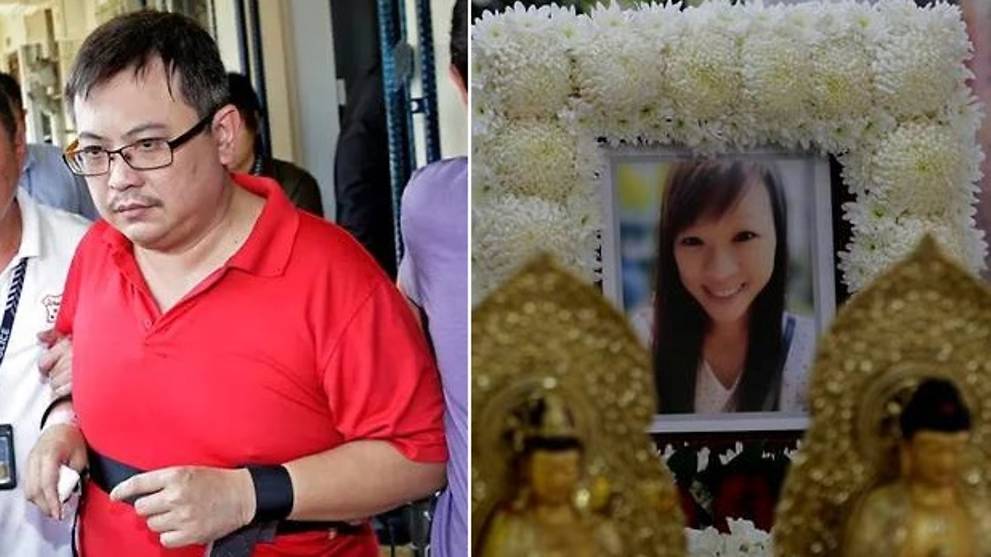
Teo Ghim Heng (in red) is accused of killing his pregnant wife Choong Pei Shan and their four-year-old daughter. (Photos: TODAY/Wee Teck Hian)
(Updated: )
Bookmark
SINGAPORE: A woman who was killed by her husband was said to have quarrelled with him moments before, telling him that he was "useless".
According to a statement by Teo Ghim Heng, heard in court on Wednesday (Jul 3), Madam Choong Pei Shan argued with her husband on the morning of Jan 20, 2017, as they were helping their four-year-old daughter change out of her kindergarten uniform.
Mdm Choong, 39, was said to have asked Teo why the girl was not going to school that day.
"I replied - I don't have money to pay her school fees," Teo said in his statement. "If she goes to school, she might be asked to leave, which will be very embarrassing."
He had S$70,000 in debts at the time.
According to him, his wife, who was six months pregnant with a boy, began scolding him.
She purportedly said: "Other families can take care of three kids. You can't even provide for a family with one child. You are so useless."
Teo said he tuned out her nagging and began to draw a blank in his mind, and could not remember what else she said, but remembered thinking she was being "very sarcastic and hurtful with her words".
"The last thing I recall her saying in Mandarin was - (daughter) look at how useless your father is," said Teo.
The court heard the above account on Wednesday during the second day of the trial against Teo. The 43-year-old former property agent-turned-sales coordinator is contesting two charges of murder, with a third charge involving his unborn child stood down.
He is accused of strangling his wife and daughter, before setting fire to their bodies. He allegedly kept the bodies on the bed in the master bedroom of his Woodlands flat for eight days, sleeping beside them and leaving the flat only for food and air freshener.
He was arrested on the first day of Chinese New Year (Jan 28, 2017) after his brother-in-law called the police to the flat.
ACCUSED WAS LATE IN PAYING SCHOOL FEES: PRINCIPAL
The former principal of the school Teo's daughter attended took the witness stand on Wednesday, detailing to the court how Teo missed payments for his child's school fees.
Ms Faizahhanim Ahmad, then the principal of Little Tree House in Sembawang, told the court that Teo paid S$850 monthly for his daughter's school fees, after government subsidies.
He was initially prompt in paying school fees, but began paying them late or in default from mid-2016.
Teo had said in statements that he wanted his wife to help support the family's income. Working mothers get S$300 in government subsidies for school fees, but non-working mothers receive only S$150.
As Mdm Choong was not working, she was not eligible for the S$300 subsidy.
Ms Faizahhanim sent Teo several text messages reminding him to pay the fees, and recounted one incident when she tried to tell Teo about it in person while he and his wife were dropping their daughter off at the school.
"I went forward to tell him, I was about to tell him he was due for payment," she said. "He came forward, nearer to me, to signal not to say anything, so I stopped at that."
Teo later sent Ms Faizahhanim a text message in which he said: "Please do not talk about school fees in front of my wife. Don't want her to know as she is pregnant and emotional now."
The former principal teared as she told the court how she and the school's teachers were shocked to hear about the alleged murders. She agreed with the defence that the couple was "quite loving" and that the incident was unexpected.
TEO SEEMED DEPRESSED, HAD MONEY ISSUES: FORMER BOSS
Husniyati Omar, who was sentenced to jail for seven years and nine months in September last year, exchanged a smile with Teo during the hearing.
She had hired Teo as a sales coordinator at her firm Carpentry Design Works in October 2016. This was after Teo made a job switch from his long-time trade as a property agent, as he was not faring well.
Teo earned a basic salary of S$1,500, excluding commission and additional allowances, Husniyati said.
She said she knew Teo had financial problems as she once saw him quarrelling with a colleague about money he owed him from illegal betting. Teo had also asked her for loans and advances, which she gave to him along with advice to stop betting.
Husniyati had told a doctor previously that Teo appeared normal and there were no episodes of him appearing depressed, behaving strangely or reacting violently.
However, she told the court on Wednesday that she knew, as she had been depressed before, that people with depression react differently. She said she knew Teo was having financial issues, but might have hidden his depression from her as he needed the job.
She said she had seen Teo with his family, and found him to be "a man trying to make his wife happy". When the family of three attended Husniyati's birthday party on Christmas Day in 2016, Husniyati said she spoke to Mdm Choong and suggested that she transfer her daughter from a private kindergarten to a public one, which is cheaper.
"She said: 'Oh no, I want the best,'" said Husniyati. "I know the difficult position (Teo) is having, as a man trying to make his wife happy."
She added that on one occasion when Teo asked her for a loan, she found out that Mdm Choong had wanted to go for a non-compulsory test in relation to her pregnancy that was "quite expensive".
"From the way I converse with the wife, it seems she wants certain things she's used to (having)," said Husniyati.
She added that Teo, who wore the same shirt to work on most days, requested for time off from 4.30pm to 6pm daily on work days so he could pick up his daughter from school and prepare dinner for his wife and daughter before returning to work from 9pm to 10pm.
She agreed with the defence that he was "very attached and very loving" towards his wife and daughter.
The trial continues in the afternoon.
If found guilty of murder, Teo faces the death penalty.
Trump makes history as first sitting US president to step into North Korea
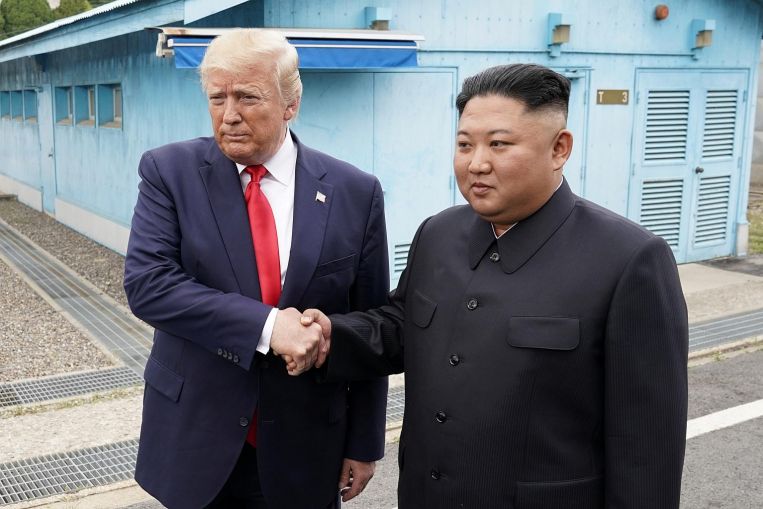
SEOUL - Donald Trump has made history by becoming the first sitting United States President to step into North Korea, in an impromptu meeting with the regime's leader Kim Jong Un which experts say demonstrated their strong rapport and injected fresh impetus into stalled nuclear talks.
But he was unsure whether Mr Kim could make it at such short notice, due to security and logistical issues.
"I never expected to see you here," a grinning Mr Kim told Mr Trump as they shook hands on Sunday (June 30) across the Military Demarcation Line (DML) in the truce village of Panmunjom.
Mr Trump later told the media he asked if Mr Kim would like him to cross the line – to which the North Korean leader replied: "I would be so honoured."
The two leaders then walked a few steps across the North Korean border and posed for photos.
"This is a historic moment, the fact that we're meeting," said Mr Trump. "I want to thank Chairman Kim for something else... if he doesn't show up the press was going to make us look very bad, so you made us both look good."
Mr Kim, in return, called the short walk a "very courageous and determined" act by the US President.
The third meeting between the two leaders – after Singapore in June last year and Vietnam in February – unfolded after Mr Trump sent a Twitter message asking Mr Kim to meet him at the DMZ to shake hands and say hello.
The US President was in Seoul for a two-day visit to meet South Korean President Moon Jae-in, while returning home from the Group of 20 leaders' summit in Osaka.
Mr Trump and Mr Kim ended up talking for nearly an hour, after which Mr Trump revealed that stalled working-level talks will be resumed in the weeks to come.
He said US Special Representative for North Korea Stephen Biegun will lead the US team with Secretary of State Mike Pompeo, while the North Korea's chief negotiator will be "someone we like".
Communication between the two sides has been minimal since their leaders failed to agree in Hanoi on how to move beyond the agreement inked in Singapore to build new ties and work towards complete denuclearisation.
Mr Kim offered to dismantle the North's main Yongbyon nuclear facility in exchange for the early easing of sanctions, but Mr Trump demanded more.
Both sides have since urged each other to come up with new proposals, while reiterating their commitment to dialogue.
Observers say the DMZ meeting is a move steeped in symbolism and historical significance, as the heavily guarded border remains a reminder of post-war pain and lingering tension.
Mr Kim agreed as much, saying that it marks a "historic shift from division to peace".
Another significant moment was the first trilateral meeting between Mr Trump, Mr Kim, and Mr Moon, also at the DMZ. But Mr Moon, who accompanied Mr Trump there, was careful to underplay the event, telling reporters that the focus should be on Trump and Kim.
The South Korean leader also lauded Mr Trump's "bold and creative" approach towards North Korea, adding that the two countries made "significant progress" by agreeing to resume working-level negotiations.
Dr Bong Young-shik of Yonsei University's Institute for North Korean Studies told The Straits Times that the DMZ meeting was a win-win situation, allowing the two leaders to save face and bask in the optics while flaunting their personal connection.
"Trump's personal approach that helps to alleviate deep-seated anxiety might be more effective than any security assurance or normal diplomacy," said Dr Bong. "But sanctions remain in place, ouch."
Unlock more articles at just $0.99/month
Subscribe to read all the stories you want today. Only $0.99/month for the first 6 months*.
Leaving Jakarta: Indonesia accelerates plans for 'green, smart' capital in the middle of Borneo wilderness
Asia
The forests of Bukit Soeharto could within years be home to hundreds of thousands of Indonesia's public servants. (Photo: Jack Board)
(Updated: )
Bookmark
SAMARINDA, Indonesia: In the late 1970s, it is told, Indonesian president Suharto embarked on a journey along the coast of East Kalimantan, a lush flank of land stretching up the island of Borneo.
From a picturesque hill, he admired the natural surroundings, a stop on what is remembered by locals as an arduous journey between the cities of Balikpapan and Samarinda. He might never have believed that a few decades later, those stretches of lush forest could become home to Indonesia's capital city.
In commemoration of the president's visit, the forest was named in his honour, and in 1991 it became a conservation area - a "great forest park".
In this landscape the foundations of a city for one million people could soon be laid.
The Indonesian government has almost finished a long awaited feasibility study into the relocation of the country's administrative core away from Jakarta. The chosen site for the new city will be announced this year, Minister of National Development Planning Bambang Brodjonegoro confirmed with CNA.
"If we can do that, then sometime in 2020 we can do all the preparation, including the masterplan and a detailed design of the new capital," he said.
"Then in 2021, all the construction activities will be started with the expectation that by 2024, we can start the first steps of the movement of the capital."
Large swathes of Bukit Soeharto has been taken over by palm oil plantations and mining operations. (Photo: Jack Board)
In shifting away from the urban density of Jakarta, the government will delve into the wilderness. The Bukit Soeharto area in East Kalimantan is a leading contender in what has become a bidding war between neighbouring provinces.
Despite a historically poor track record of environmental preservation, the Indonesian government wants to change the way it is perceived and showcase nature by constructing a city right among the trees.
"If this location is very close to the forest area in Kalimantan then the design of the city will be like a forest city. The city will actually revitalise the protected forest," Bambang said.
"The motto of the city will be Smart, Green and Beautiful. A green city will be at the heart of our plan."
President Joko Widodo has made massive infrastructure the signature priority of his leadership, investing billions in projects nationwide. But this represents a challenge with a different magnitude.
The ambitious timeline that has been proposed would giveJokowi a red-tape cutting moment in the eleventh hour of his presidency. It could coincide with the last year of his second and final term as the nation's leader.
But there are many hurdles ahead, with plenty of critics who remain sceptical about the government's ability and motivation to pull it off.
Jakarta suffers from serious congestion. (Photo: Pichayada Promchertchoo)
'MIDDLE OF NOWHERE'
A move now is more than just economics - there is symbolism encircling the decision. Java - with Jakarta its beating heart - has been the centre of everything in a sprawling nation that spans wider than western Europe or the North American continent.
Now it needs to be saved from itself, says Bambang. The proposed new capital will be located in Kalimantan, he confirmed, the geographic heart of the country that is deemed safe from Indonesia's risk of natural disasters. It is also a nod to the forgotten lands and people of the archipelago.
Minister Bambang Prodjonegoro told CNA the government will announce the outcome of its feasiblility study later this year. (Photo: Jack Board)
"Moving the capital is part of the strategy of reducing inequality, especially inequality between Java and outside Java. The burden of Java is too big so now we understand that we also need to save Java," Bambang said.
"We want to diversify. We want to create new sources of growth."
Jakarta has a pressing range of problems expected to imperil the liveability of the city in the coming decades. The megalopolis is known to be sinking, while issues of overcrowding, congestion and poverty have added to its citizens' woes.
Elisa Sutanudjaja, the executive director of Rujak Center for Urban Studies doubts that shifting the capital from Jakarta will lead to any major improvements for its residents, given the number affected is just a small fraction of the 30 million plus population.
In fact, she does not believe the plan will happen at all.
"It takes too much effort, from law revision to ensuring that the budget is there. For me, it's just a bad example of land speculation," she said.
"Despite moving the capital, the national government still has to overcome Jakarta's problems, because many of those problems are produced and created by the impact of national government's policies."
A massive toll road is near completion to connect to Balikpapan and Samarinda. (Photo: Jack Board)
Ben Bland, research fellow and director of the Southeast Asia project at the Lowy Institute, an international policy think tank, says the strategy appears to be earnest, but more progress and information needs to be shown before Indonesians will be convinced.
The details of the feasibility study remain secretive and there has been little public discussion or oversight.
"Given that this has issue has been discussed for so long without progress, investors and civil servants are unlikely to take the government seriously until there are concrete moves to make this happen," Bland said.
There are lessons to be learnt from the experiences - good and bad - of other nations who have undertaken, or are attempting, the mammoth task of moving their capital, from Brazil to Myanmar, Malaysia and Egypt.
Some have been successful in decentralising crowded capitals, but other projects have been left as white elephants, with ghost cities having to be endured by public servants.
Thus, a well rounded choice of location in such an expansive nation is critical, explained Bambang.
"We are trying to avoid the location that can be categorised as the middle of nowhere."
LEGACIES OF PRESIDENT'S PAST
The concept of breaking ground for a new capital city is not new. In fact, proposals to move from Jakarta have dotted Indonesia's modern history.
It was the founding president himself Sukarno that put a relocation on the agenda back in the 1950s in the early years of Indonesia's independence. President Suharto also wanted to shift the capital in the 1990s to a nearby city in Java, a plan shafted when he resigned.
The legacies of both former leaders hang over critical choices being made now about Indonesia's future.
The legacy of former president Sukharno still holds sway over Kalimantan. (Photo: Jack Board)
The people of Palangkaraya in Central Kalimantan believe there is a destiny in their city becoming capital. From its inception, it was modelled on Washington DC with a large traffic circle, mall and wide avenues, engineered by Russians.
"Sukarno wished to build a new city like Washington DC, a new type of city to be a model for Indonesia. His ambition was to realise it in Palangkaraya," said Central Kalimantan Governor Sugianto Sabran.
That vision will be complicated by contemporary challenges of land ownership and availability. Palangkaraya is far from a bustling city, but with a population of about 250,000 people, it cannot simply be supplanted.
"Most of the land is already owned by people and occupied. And the area itself mostly is swamp or peatland. It is more natural if they build a new city," said Wijanarka, local architect and university lecturer.
An area north of the city has been proposed that straddles three local regencies, dubbed the "Palangkaraya Triangle". There is ample room for the construction of a large city, which would be flanked by two major rivers. It is an area being properly examined by the planning ministry.
It has the support of many Palangkaraya residents, excited about the prospect of the hum of economic activity and investment in their area. "Palangkaraya is safe, there are no protests, no rallies and it's peaceful. We locals are ready," long term resident Dwi Subagyo boasted.
Palangkaraya was designed with similar features to Washington DC, in preparation for it to become capital. (Photo: Jack Board)
Yet, despite the keenness, history and nostalgia connected to Palangkaraya, there are obvious weaknesses to the bid, such as a lack of significant infrastructure and access to a seaport - both key criteria in the central government's feasibility study. The city is inland, meaning the construction of hundreds of kilometres of major roads to the coast would be needed.
"We are trying to utilise economies of scale by locating the new capital not too far from functional cities, functional areas and of course the availability of infrastructure," Bambang said.
"We do not expect to build a new big airport, a new seaport or big road networks like a toll road for the capital."
These measures tilt the candidacy favour back towards East Kalimantan and the sweeping hills of Bukit Soeharto.
Residents of Palangkaraya believe it is destiny that their city will become capital. (Photo: Jack Board)
DEEP SCARS
The area lies in the middle of two major, coastal cities - Balikpapan and Samarinda, which are currently having their connectivity improved by a multi-lane toll road due for completion soon. Both cities boast working ports, modern airports and tourism sites that could be further developed.
"We hope the president will choose East Kalimantan as we already have infrastructure which does not really need much improvement," said acting East Kalimantan province secretary Muhammad Sabani.
Still, it is not these types of infrastructure that have environmentalists worried, rather the need to build an entire city from scratch over thousands of hectares.
"If the new capital city is going to be built there, the function of the forest will change. The development of hotels and shopping centres will need extensive land clearing. We actually reject the plan," said Hafidz Prasetyo, advocacy and campaign department head for environmental NGO Walhi in East Kalimantan.
"As a conservation area, it should be a home for sun bears, local birds and other kinds of animals as well as teak woods, bengkirai woods and those should be preserved," he said. "It's better for the government to rethink the plan. Please consider the condition and future of the forest park, which later will affect other areas."
Bukit Soeharto has gone through plenty of iterations during the past decades. In a former generation, the area became a production timber forest. It has been reclassified several times but principally has been set aside for conservation in recent times. It is land owned and controlled by the state.
Orangutans live in a pristine wildlife sanctuary just a few kilometres from the proposed site of the new capital in Bukit Soeharto.
Today, it is far from pristine terrain, though in parts the forest is still dense and unyielding. Humans have left deep scars here already, particularly in the last ten years, locals say. Small scale coal mines and smatterings of palm oil plants have been allowed to intrude into what is a designated protected area. Illegal deforestation and frequent forest burning have further degraded the quality of the land.
Just a few kilometres from the proposed site of the new capital, a sanctuary exists for rescued orangutans and sun bears showcases the differing fates between public and private land.
The hundreds of individual animals living at the Borneo Orangutan Survival Foundation enjoy a life of protection away from their natural habitats ravished by human activity throughout the region.
For Hafidz, the government's strategy of transforming a forest into a city is representative of the country's cavalier attitude towards the environment. "Bukit Soeharto looks pristine but there are plenty of forest encroachers. So what's the difference between them and the government?"
Still, for the locals in the area, there is a building excitement about the potential announcement. It would be transformative for their lives, even if it results in their likely eviction from the area.
"When Pak Jokowi visited this area, we lined up outside to see him. It was so exciting," said Putri Ayu, one of about 15,000 people living inside the bounds of Bukit Soeharto. "I also know that East Kalimantan is one of the candidates for the new capital and I support it," Suryana agreed.
In their favour, the president appeared to show an enthusiastic interest in the area during a recent tour of various relocation sites. "Here, I see that everything is supportive," President Jokowi was reported as saying by local media.
If he can make it happen, he will have achieved something that has eluded all of this forebears. Even if his time in office elapses long before the city truly takes root.